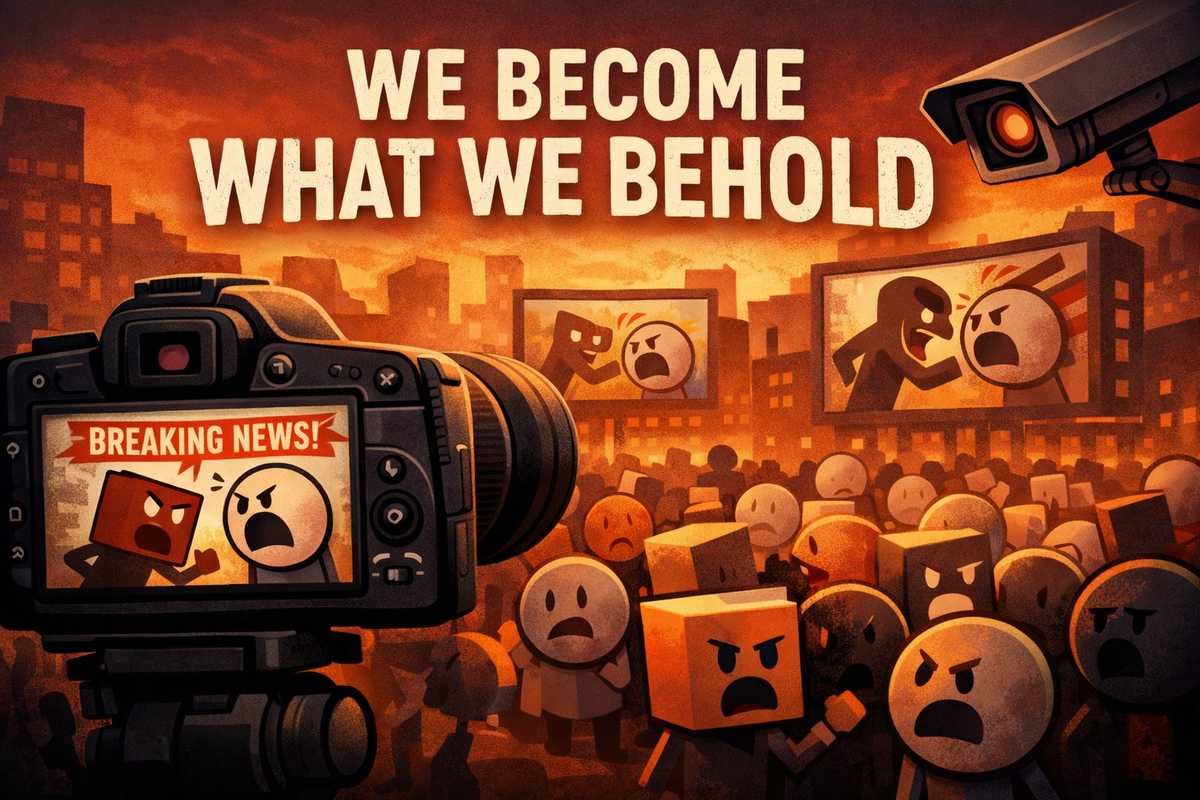
We Become What We Behold is a short yet deeply meaningful interactive experience that explains how media representation influences public behavior and social division. The game presents a simplified society, but the ideas it communicates are complex and highly relevant to real-world media dynamics. Through minimal design and deliberate player interaction, it highlights how repeated exposure to specific narratives can reshape how people think, act, and react.
This article explores the game from an informative perspective, focusing on its mechanics, psychological themes, media commentary, and societal relevance.
Origin and Development of the Game
The game was created as an experimental project to demonstrate the consequences of attention-driven media systems. Instead of long gameplay or complex storytelling, it relies on symbolic characters and short playtime to deliver its message effectively. The simplicity of its design ensures accessibility for all users while maintaining intellectual depth.
Its development reflects a growing trend in interactive media where games are used not only for entertainment but also as tools for education and social critique.
Overview of Gameplay Structure
The gameplay places the player in the role of a photographer responsible for capturing moments within a community. These moments are then displayed as headlines, shaping how the society perceives itself. Initially, interactions are neutral and peaceful, but the tone shifts depending on what the player chooses to highlight.
The mechanics are intentionally repetitive to reinforce how small choices, when repeated, can produce large-scale consequences.
How Player Choices Shape Society
Every action taken by the player directly affects the behavior of the characters. When neutral interactions are shown, society remains calm. When aggressive or fearful moments are emphasized, tension escalates. This reflects how media framing can exaggerate isolated incidents and turn them into perceived social norms.
The game does not punish the player mechanically; instead, it allows consequences to unfold naturally, reinforcing accountability through observation rather than failure screens.
Media Amplification and Narrative Control
A central message of We Become What We Behold is the power of amplification. Media rarely invents events but often decides which ones receive attention. By focusing on extremes, media outlets unintentionally normalize conflict and fear.
The game demonstrates how selective storytelling creates distorted realities, where people begin acting based on what they believe society has become, not what it actually is.
Psychological Impact of Repeated Exposure
Repeated exposure to specific types of content influences emotional responses and expectations. When people constantly see fear-driven narratives, they become more defensive and suspicious. The game mirrors this psychological shift by showing how characters gradually lose trust and adopt aggressive behavior.
This reflects real psychological principles such as conditioning and cognitive bias, where perception becomes shaped by frequency rather than accuracy.
Symbolism in Character Design
The use of simple shapes instead of realistic characters removes cultural, racial, or political identifiers. This abstraction ensures that the message remains universal. Squares and circles are not meant to represent specific groups but rather the concept of “us versus them.”
This design choice allows players to project real-world scenarios onto the game without feeling targeted or defensive.
Escalation of Conflict Through Observation
As the game progresses, neutral interactions disappear, and conflict becomes the dominant narrative. This shift illustrates how observation itself can become a catalyst for change. When people believe they are being watched or judged, they adjust behavior accordingly.
The game effectively demonstrates how surveillance and constant exposure can accelerate societal breakdown when paired with negative framing.
Reflection of Real-World Media Cycles
The patterns shown in We Become What We Behold closely resemble real media cycles. Sensational headlines generate engagement, which encourages more of the same content. Over time, nuanced discussions are replaced by extremes.
The game serves as a condensed simulation of how this cycle functions, making abstract media theory tangible and easy to understand.
Educational Value of the Game
Despite its short length, the game is widely used in educational settings to explain media literacy. It encourages players to question not only what they consume but also what they choose to share.
By actively involving the player, the game transforms passive learning into experiential understanding, making its lessons more memorable.
Ethical Responsibility of Content Creators
One of the strongest implications of the game is the ethical responsibility held by content creators, journalists, and influencers. Highlighting certain narratives over others carries consequences, whether intentional or not.
The game emphasizes that neutrality is not achieved by silence but by conscious balance in representation.
Societal Implications and Awareness
The broader implication of the game lies in awareness. It does not provide solutions but encourages reflection. By showing how easily harmony can collapse, it urges individuals to be more mindful of their role in spreading narratives.
This awareness is crucial in an era where anyone can act as a publisher through social media platforms.
Why the Message Remains Relevant Today
The relevance of We Become What We Behold has only increased with time. Algorithm-driven platforms prioritize engagement, often favoring emotionally charged content. This environment mirrors the game’s mechanics almost perfectly.
The game remains a powerful reminder that attention is not neutral and that what society focuses on shapes its future.
Conclusion: Understanding the Power of Attention
At its core, the game teaches a simple but profound lesson: attention shapes reality. By choosing what to observe, record, and amplify, individuals and media collectively influence social behavior.
We Become What We Behold succeeds because it transforms this abstract idea into an interactive experience, leaving players with a deeper understanding of media influence and personal responsibility.
More Details : Avatar World: The Ultimate Virtual Life Game Redefining Imagination
FAQs
What is the main message of We Become What We Behold?
The game explains how selective attention and media framing can influence societal behavior and escalate conflict.
Is We Become What We Behold educational?
Yes, it is widely used to teach media literacy, psychology, and social awareness.
How long does it take to complete the game?
The game typically takes less than ten minutes to complete.
Why does the game use simple shapes instead of people?
The abstraction makes the message universal and avoids targeting specific groups.
Is the game still relevant today?
Yes, its themes closely align with modern social media and news consumption patterns.