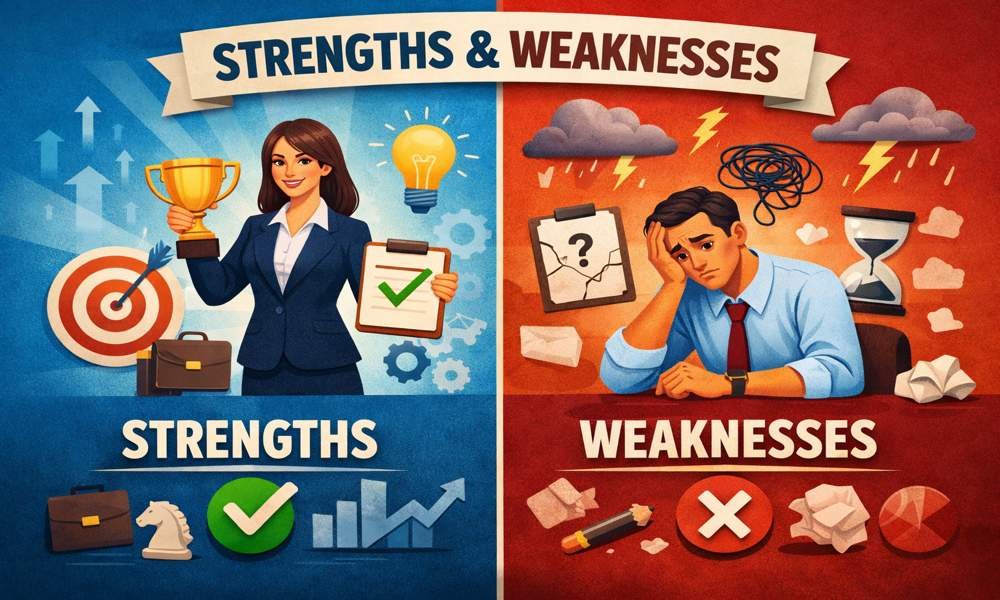
Job interviews are one of the most defining moments in a professional career. A single answer can open the door to your dream role—or keep you searching. Among the most commonly asked interview questions, the one that almost every candidate fears is: “What are your strengths and weaknesses?”
Responding effectively requires strategy. Employers are not looking for a perfect person—they are searching for honesty, self-awareness, and growth potential. In this article, you will learn how to identify, frame, and present your personal qualities in a way that leaves a memorable impression. Let’s explore the strengths and weaknesses most valued in the professional world today and how you can shape your answers.
Why Employers Ask About Your Personal Strengths and Weaknesses
Hiring managers want more than skills; they want insight into your personality.
They use this question to evaluate:
- Your ability to reflect on your performance
- Whether you possess qualities that match their work culture
- If you are open to growth and learning
- How well you handle pressure and self-improvement
Employers are not testing confidence alone; they want alignment. A person who can recognize areas of improvement and act on them is more valuable than someone who claims to be flawless.
Top 10 Professional Strengths to Mention (Examples With Explanations)
Below are examples that interviewers love hearing because they reflect real-world workplace value:
1️⃣ Strong Communication Skills
Clear communication allows you to deliver messages without confusion, handle conflict, and connect with teams effectively. Mentioning this shows that you can collaborate, report updates, and speak confidently in professional settings.
2️⃣ Leadership and People Management
Leadership is not only about managing; it is about inspiring others. Interviewers appreciate candidates who can organize a group, delegate, and motivate even without having a management title.
3️⃣ Adaptability in Fast-Changing Environments
Industries evolve quickly. Adaptability demonstrates that you can learn new tools, handle shifting deadlines, and remain productive during change.
4️⃣ Problem-Solving Abilities
Employers value someone who doesn’t wait for instructions every time a problem arises. Show an example of a challenge you solved without being asked.
5️⃣ Creativity and Innovative Thinking
Creative thinkers offer new solutions and prevent companies from falling behind competitors. This strength works well in marketing, media, tech, and even customer service.
6️⃣ Strong Time-Management
Companies want people who can prioritize tasks, meet deadlines, and organize work efficiently. Time-management means fewer errors and more productivity.
7️⃣ Teamwork and Collaboration
Success in most companies depends on shared effort. Showing that you listen, support others, and contribute in groups is a major advantage.
8️⃣ Work Ethic and Reliability
Arriving on time, completing tasks without reminders, and remaining consistent show professionalism. Employers view reliability as a long-term asset.
9️⃣ Analytical Thinking and Data Interpretation
In a digital world, companies rely on metrics. Analytical thinkers help improve performance with insights, not guesses.
🔟 Positive Attitude and Emotional Resilience
A positive mindset impacts the workplace more than most people realize. Someone who handles stress without spreading negativity is a powerful asset.
Best 10 Weaknesses to Mention (And How to Present Them Professionally)
Talking about weaknesses is more delicate. You must avoid harmful traits (like being lazy) and instead highlight areas you are actively improving.
1️⃣ Over-Working and Burnout Risk
Some candidates push themselves too hard. Frame this by explaining how you now maintain better balance and boundaries.
2️⃣ Public Speaking Nerves
Many professionals fear presenting. This is a great weakness to share when you also show you’re practicing to improve.
3️⃣ Difficulty Delegating Tasks
Highly responsible workers often try to do everything themselves. Explain how you now trust teams more and use delegation tools.
4️⃣ Saying “Yes” Too Often
People-pleasers struggle to decline additional work. You can show improvement by mentioning scheduling strategies you now use.
5️⃣ Struggling With Criticism
Taking feedback personally is common. Employers appreciate honesty when you also mention that you now view feedback as development.
6️⃣ Lack of Experience in a Software or Tool
If you’re applying for a role and lack one small technical skill—this is an ideal weakness. Pair it with: “I am currently taking a course to improve.”
7️⃣ Being Impatient With Delays
Driven workers dislike slow results. Showing how you now remain patient with longer-term projects demonstrates maturity.
8️⃣ Perfectionism
Perfectionists sometimes over-edit or spend too long on small details. Explain how you now balance quality with deadlines.
9️⃣ Hesitation to Ask for Help
This can hinder productivity. Show that you’re learning to communicate earlier when you need guidance.
🔟 Limited Industry Experience
If you’re new to a field, acknowledge it—but emphasize your willingness to learn rapidly.
How to Answer the Question During an Interview (Simple Strategy)
Instead of memorizing, use this format:
✔️ The 3-Step Strength Answer Formula
1️⃣ State your strength clearly
2️⃣ Give a short example of how you applied it
3️⃣ Show how it benefited results
Example:
“I have strong analytical thinking. In my last role, I used data tracking tools to identify customer behavior patterns, which helped increase monthly sales.”
✔️ The 3-Step Weakness Answer Formula
1️⃣ Be honest
2️⃣ Add how you’re improving
3️⃣ Show willingness to grow
Example:
“I used to struggle with public speaking, but I enrolled in a communication workshop and now volunteer to lead weekly team updates.”
How to Choose the Right Strengths and Weaknesses for YOUR Career
Different industries value different traits. Match your qualities to the job.
For Customer Service & Retail Jobs
- Strength: communication, patience, empathy
- Weakness: difficulty saying no, impatience with slow systems
For Corporate Office Roles
- Strength: organization, analytical thinking, teamwork
- Weakness: delegating tasks, public speaking
For Leadership & Management Positions
- Strength: decision-making, conflict resolution, leadership
- Weakness: being overly involved in small details
By customizing answers, you present yourself as a perfect cultural and skill match.
Tips to Increase Your Chances of Getting Hired
Maximizing your interview success goes beyond knowing your strengths and weaknesses. Consider the following strategies:
- Research the company deeply before answering
- Prepare at least 3 strengths and 2 weaknesses
- Use real examples instead of generic words
- Practice out loud before the interview
- Stay confident—but humble
Preparation builds confidence. Confidence builds opportunity.
❓(FAQs)
1️⃣ What is the best way to talk about weaknesses in an interview?
Always choose a weakness that won’t harm the job and explain how you’re actively improving it.
2️⃣ Should I mention personal weaknesses like anxiety or shyness?
Only if framed professionally—otherwise choose workplace-related examples.
3️⃣ How many strengths and weaknesses should I share?
Most interviewers expect one or two of each, with short examples.
4️⃣ Can I say I have no weaknesses?
No—this shows poor self-awareness and may hurt your hiring chances.
5️⃣ What if my weakness is lack of experience?
That is acceptable—pair it with your plan to learn or training you’re enrolled in.
Final Words:
Understanding and presenting your Strengths and Weaknesses is a powerful interview skill that sets candidates apart in a competitive market. When approached thoughtfully, this question becomes your greatest opportunity—not your greatest fear. Use honesty, examples, and a willingness to grow, and you will stand out as a confident, capable, and self-aware professional ready for success.
More Details : Business Guide Dismoneyfied: The Ultimate Roadmap to Launching a Profitable Business Without Funding