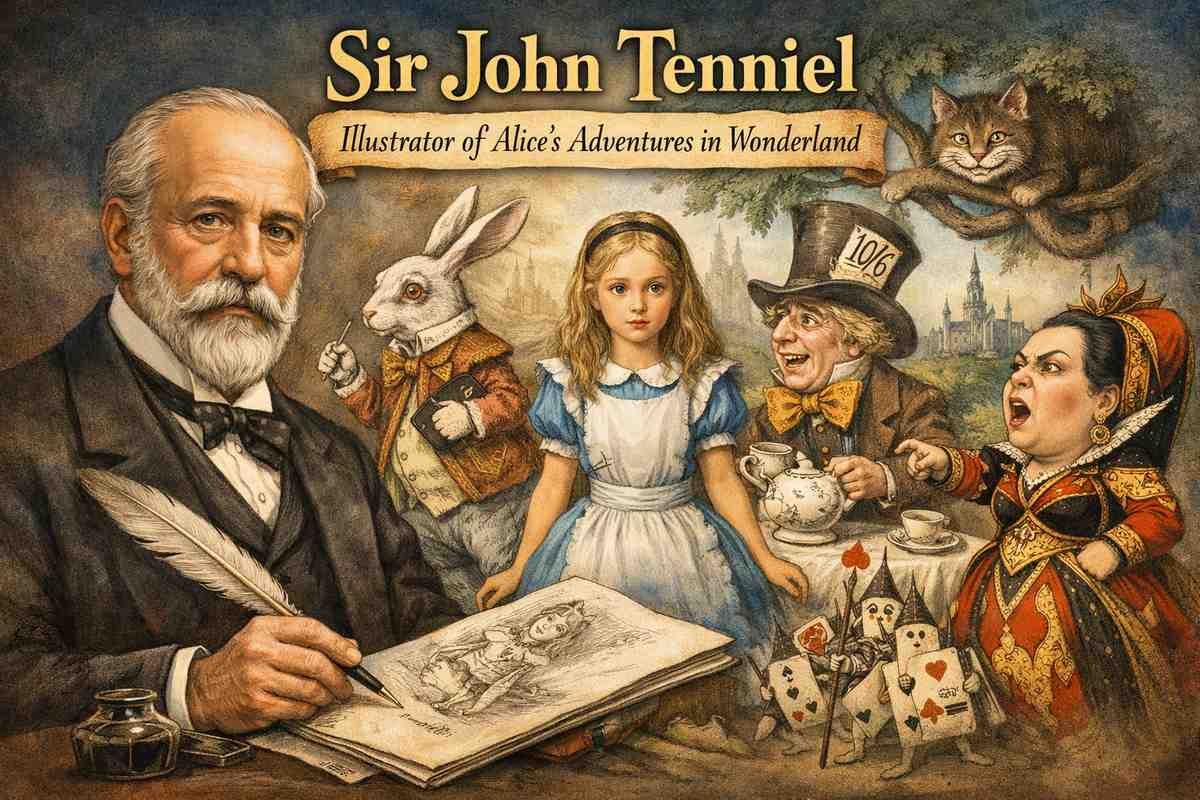
Sir John Tenniel stands among the most influential illustrators of the nineteenth century, shaping how generations visualize classic literature and political satire. Working during the height of the Victorian era, he developed a precise, disciplined style that balanced realism with imaginative detail, setting new standards for book illustration and editorial cartooning. His images were not decorative afterthoughts; they were integral to storytelling, interpretation, and public discourse.
Early Life and Artistic Formation
Born in London in 1820, Tenniel grew up in a culturally rich environment that valued drawing, printmaking, and literature. Largely self-taught, he refined his observational skills by studying sculpture, classical art, and contemporary illustration. A childhood fencing accident left him blind in one eye, which may have contributed to his remarkable visual memory and careful composition. These early experiences shaped an artist capable of rendering complex scenes with clarity and control.
Victorian Britain and the Rise of Illustration
The nineteenth century witnessed an explosion in printed material, from serialized novels to illustrated magazines. Advances in wood engraving made detailed images affordable for mass audiences. Within this context, Sir John Tenniel emerged as a central figure who understood how illustrations could guide readers’ interpretations. His work reflected Victorian values—discipline, morality, and social order—while also revealing subtle humor and critique.
Defining Work in Literary Illustration
Tenniel’s most celebrated contribution lies in his illustrations for Alice’s Adventures in Wonderland by Lewis Carroll. These images did more than accompany the text; they defined characters, settings, and emotional tone. The White Rabbit, the Mad Hatter, and the Queen of Hearts became visually fixed in the public imagination largely through Tenniel’s pen.


Visual Storytelling Techniques
One of Tenniel’s greatest strengths was narrative clarity. He composed scenes to guide the reader’s eye, emphasizing gestures, facial expressions, and spatial relationships. His figures are grounded in anatomical accuracy, yet they remain expressive and theatrical. This balance allowed readers to follow complex, often surreal narratives without confusion.
Character Design and Symbolism
The characters Tenniel designed were not arbitrary. Each carried symbolic weight rooted in Victorian culture. Authority figures often appear rigid and exaggerated, while whimsical characters display controlled absurdity. Through costume, posture, and expression, Tenniel conveyed social roles and psychological traits, enriching the literary text with visual subtext.
Political Cartoons and Public Influence
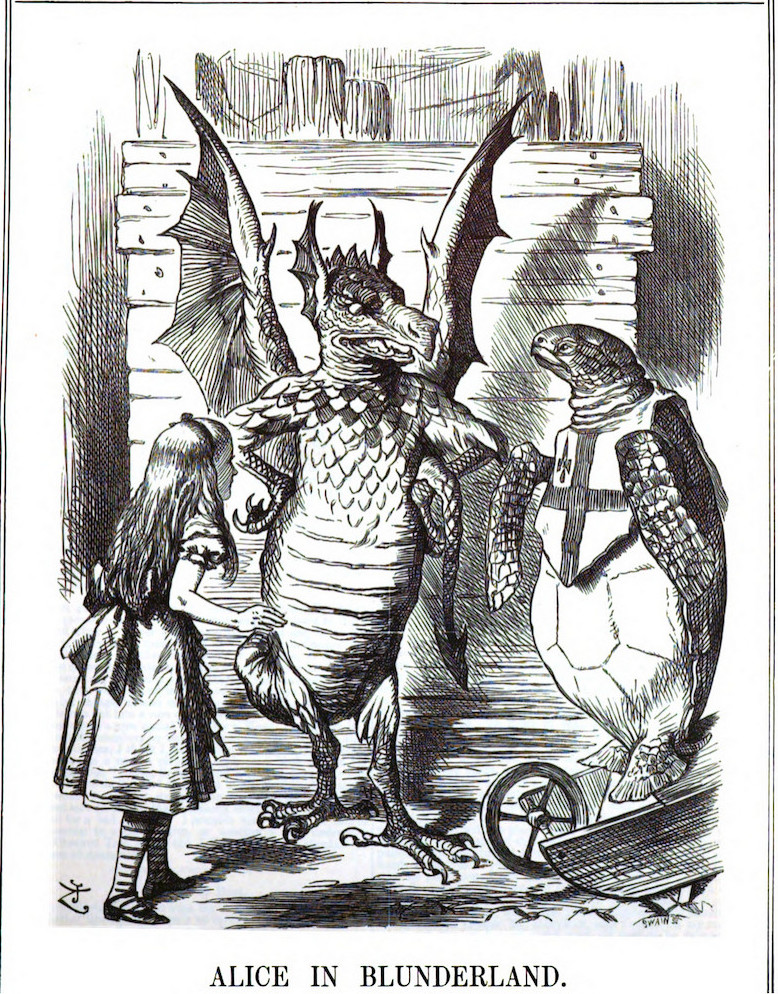
Beyond children’s literature, Sir John Tenniel was a dominant force in political cartooning. As the principal cartoonist for Punch magazine for over fifty years, he shaped public opinion on domestic and international affairs. His cartoons addressed monarchy, parliamentary reform, imperial politics, and foreign relations with sharp wit and visual authority.
Artistic Discipline and Working Methods
Tenniel was known for his meticulous process. He often visualized scenes entirely in his mind before committing them to paper, rarely relying on models. This mental discipline resulted in consistent proportions and coherent scenes. His line work was clean and deliberate, designed to reproduce well through engraving without losing detail.
Relationship Between Text and Image
In Tenniel’s approach, illustration and text existed in dialogue. He collaborated closely with authors and publishers to ensure visual consistency. For Alice’s stories, his interpretations sometimes influenced later editions of the text itself, demonstrating the power of illustration to shape literary canon.
Reception During His Lifetime
During his career, Tenniel enjoyed widespread recognition and respect. His knighthood in 1893 acknowledged his cultural contribution, particularly in political satire. Unlike many illustrators whose fame faded, he maintained relevance for decades, adapting to changing tastes while preserving his distinctive style.
Influence on Later Illustrators
The visual conventions Tenniel established became reference points for future illustrators. His balanced compositions, narrative clarity, and character-driven imagery influenced children’s book illustration well into the twentieth century. Even artists who consciously departed from his style often did so in response to the standards he set.

Legacy in Modern Visual Culture
Today, adaptations of Alice in film, animation, and digital media continue to echo Tenniel’s original designs. His imagery has proven remarkably adaptable, demonstrating structural strength beneath stylistic detail. Museums, libraries, and scholars continue to study his work as a benchmark of nineteenth-century visual storytelling.
Preservation and Scholarly Study
Original drawings and prints by Tenniel are preserved in major collections, offering insight into Victorian print culture and artistic practice. Academic research often highlights his role in bridging fine art and popular media, making sophisticated visual communication accessible to broad audiences.
Why Tenniel Still Matters
Sir John Tenniel remains relevant because his work exemplifies how illustration can clarify, interpret, and elevate text. His images are not confined to their historical moment; they continue to inform how stories are visualized and understood. For students of art, literature, and media, his career offers a model of artistic integrity and cultural impact.
FAQs
Who was Sir John Tenniel best known for illustrating?
He is best known for illustrating Alice’s Adventures in Wonderland and its sequel, defining the visual identity of the story.
What artistic style did Tenniel use?
He combined realistic anatomy with controlled exaggeration, emphasizing clarity, balance, and expressive detail.
Did Tenniel only work on children’s books?
No, he was also a major political cartoonist, especially for Punch magazine.
Why are Tenniel’s illustrations still influential today?
They established enduring visual archetypes and narrative techniques that continue to shape illustration and adaptation.
Where can original Tenniel artworks be seen?
His works are held in major museums and library collections, particularly in the United Kingdom.