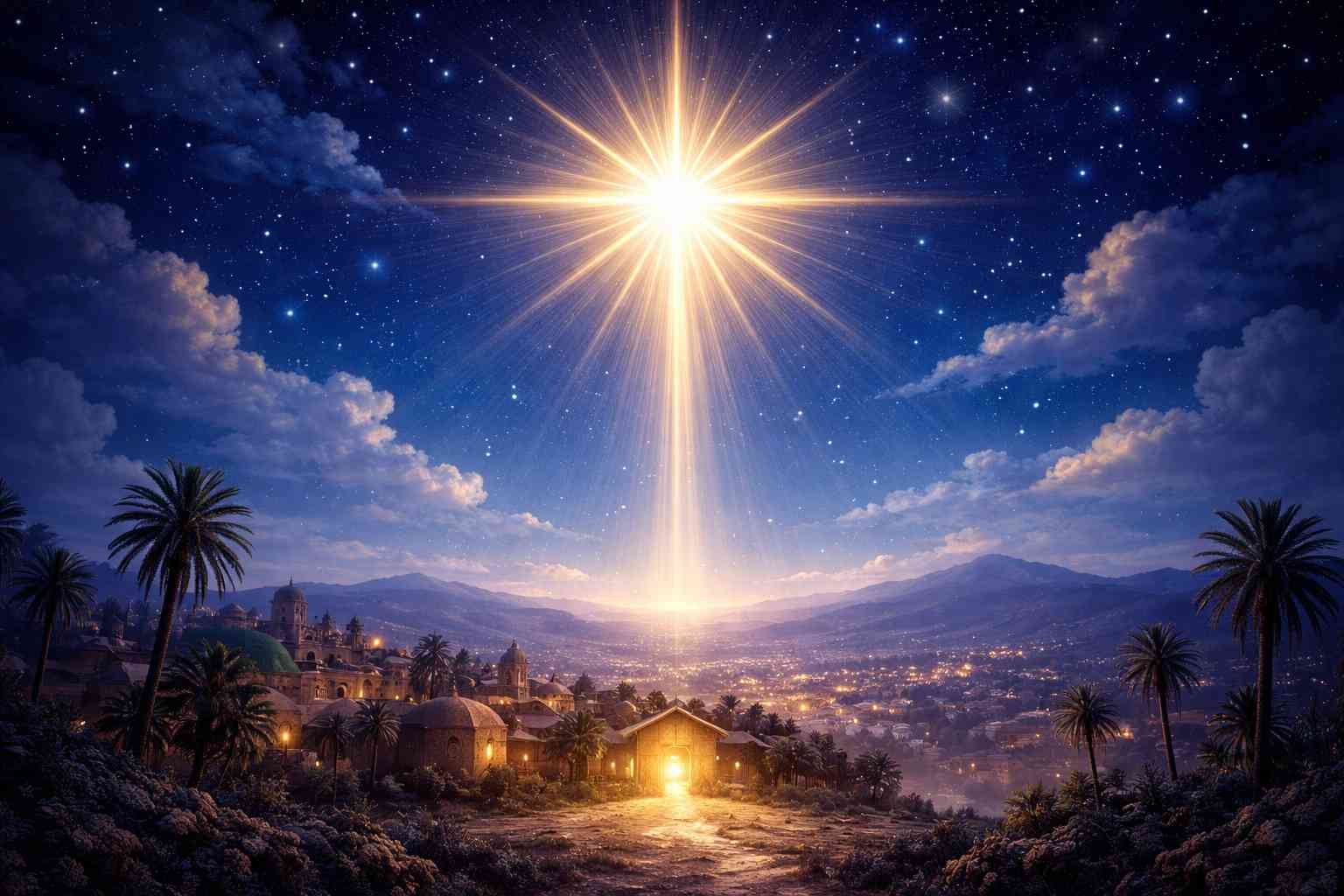
Across cultures and centuries, the Christmas star has stood as one of the most iconic symbols of the holiday season. It appears in art, traditions, nativity scenes, and atop decorated trees around the world. But behind this gentle symbol lies a rich mixture of history, astronomy, theology, and cultural storytelling. What was this mysterious light that guided ancient travelers? And why does its meaning still resonate so deeply today?
This article explores the roots, scientific theories, and lasting impact of the star that changed history.
The Historical Foundations of the Star Story
The earliest written account of the Christmas star appears in the Gospel of Matthew, describing a bright sign in the sky that led the Magi to the birthplace of Jesus. These travelers, often referred to as wise men, were scholars who studied celestial movements.
In ancient societies, unusual astronomical phenomena were widely believed to signal major political or spiritual events. For people at the time, a brilliant object appearing suddenly in the night sky would have carried deep significance. The biblical account therefore fits naturally into the worldviews of ancient astronomers and spiritual thinkers.
Understanding Who the Magi Were
To understand the star, it helps to consider the Magi themselves. They were likely highly educated astrologer-priests from regions such as Persia or Babylon. Their training involved interpreting the meaning of stars, planets, and rare celestial alignments.
For them, the appearance of a unique light in the sky would not have been a random occurrence but a sign pointing toward something extraordinary. Their long journey demonstrates how deeply such events influenced people in the ancient world.
Ancient Cultures and Celestial Messages
Long before Christianity, civilizations around the world believed that the heavens communicated messages. Egyptians aligned pyramids with stars, Babylonians recorded planetary paths, and Greeks assigned mythological meaning to constellations.
So when the Christmas star appeared in early Christian writings, early readers would have immediately understood it as a powerful symbol. Over time, this story blended with local customs, expanding its meaning and influence across continents and generations.
Scientific Theories: What Could the Star Have Been?
Researchers have proposed multiple scientific explanations for the Christmas star, each grounded in known astronomical events. While we cannot prove any single theory, several possibilities stand out:
1. A Planetary Conjunction
One of the most widely accepted theories is a rare alignment between Jupiter and Saturn around 7 BCE. When two bright planets move close together, they can appear as one striking object in the sky. Such a conjunction would have been highly noticeable to skilled sky watchers like the Magi.
2. A Comet
Comets often produce glowing tails that ancient cultures interpreted as signs of dramatic change. Chinese astronomers recorded visible comets around the era of Jesus’ birth, making this another plausible explanation.
3. A Supernova
A supernova is the explosion of a star, producing a sudden flash so bright it can outshine entire galaxies. If one occurred during the period in question, it would have been visible for weeks or even months, matching descriptions of a long-lasting guiding light.
4. A Rare Triple Alignment
Some astronomers suggest a series of astronomical events—multiple conjunctions occurring over months—may have created a repeated “sign” that drew the Magi’s attention.
These theories demonstrate how a natural event could have inspired a story that later grew into one of history’s most meaningful symbols.
Astrology’s Role in Understanding the Star
In the ancient world, astronomy and astrology were intertwined. The Magi would have interpreted the appearance of a rare celestial event as a sign tied to kingship, prophecy, or major cultural transformation.
For example, Jupiter symbolized royalty in many ancient traditions. If Jupiter appeared prominently in the sky during a conjunction, the Magi may have interpreted this as signaling the birth of an important ruler.
Thus, the Christmas star was not simply an object of beauty—it carried layers of symbolic meaning that ancient scholars were trained to decode.
Symbolism and Spiritual Meaning Through the Ages
As Christianity spread, the star took on deeper religious significance. It became a symbol of divine guidance, heavenly promise, and spiritual revelation. In Christian tradition, the star represents hope, direction, and the arrival of light during darkness.
Even outside religious contexts, people today interpret the star as a sign of inspiration, new beginnings, and the human desire to seek something greater than oneself.
The Star in Art, Culture, and Literature
Throughout history, the star has inspired countless works of art and storytelling:
- Renaissance paintings often depict an oversized star glowing above Bethlehem.
- Poets use the star as a metaphor for destiny and direction.
- Modern films employ the symbol to evoke wonder and emotional depth.
These creative interpretations reinforce how deeply the Christmas star is woven into global culture, extending far beyond its biblical origins.
Astronomers Revisit the Mystery Today
Modern researchers continue to study ancient records and recreate historical sky patterns using advanced software. These simulations allow scientists to pinpoint when significant celestial events occurred and how they would have appeared to observers in the Middle East.
Although there is no definitive scientific answer, these studies provide new insight each year, keeping public curiosity alive and maintaining global interest in the star’s origins.
Global Traditions Shaped by the Star
Across the world, cultures express the story of the star in unique ways.
Examples:
- In the Philippines, families create stunning star-shaped lanterns called parols.
- In Europe, star-bearers lead holiday processions.
- Many households place shining stars in their windows to symbolize peace and welcome.
These traditions show how a single story grew into a universal symbol of celebration and unity.
The Christmas Star in Modern Holiday Imagery
Today, the star appears on greeting cards, decorations, digital artwork, and holiday branding. Its minimalistic shape makes it instantly recognizable, while its symbolism evokes warmth, nostalgia, and joy.
Even in secular settings, the star continues to represent guidance and hope—values that resonate deeply across cultures.
Why the Story Still Matters
The enduring power of the Christmas star lies in its universal message: the search for light during times of uncertainty. Whether interpreted spiritually, historically, or scientifically, the story encourages reflection on purpose, destiny, and human connection.
Its mystery invites curiosity. Its symbolism inspires hope. And its legacy continues to shape how people celebrate the season.
More Details : Tarayummy: Height, Age, and Full Biography of the Social Media Star
FAQs
1. Was the Christmas star a real astronomical event?
Possibly. Planetary conjunctions, comets, and supernovas are leading scientific explanations supported by historical records.
2. Why did the Magi follow the star?
As trained sky observers, they interpreted unusual celestial events as signs of major spiritual or political developments.
3. How often do such bright sky events occur?
Large conjunctions and visible comets are rare but predictable. Some occur only once every many centuries.
4. Why is the star a major symbol in Christmas celebrations?
It represents guidance, hope, and the arrival of light—a message that resonates universally.
5. Does the star have meaning outside religion?
Yes. Many people see it as a symbol of inspiration, optimism, and the human desire to reach for something greater.