The tanaga is one of the most treasured traditional poetic forms in the Philippines. It is known for its compact structure, deep meaning, and lyrical quality. Historically, the tanaga was used by early Filipino poets to express insights about life, nature, morality, and culture. What makes it stand out is its strict syllabic pattern and rhyme scheme, which showcases the artistry and discipline of Filipino literature.
In this article, you will learn everything about the tanaga, including its structure, themes, history, and a detailed tanaga example to guide beginners who wish to write their own.
What Is a Tanaga?
A tanaga is a traditional Filipino poem with four lines, each containing seven syllables, following a specific rhyme pattern.
Its classic form uses the AABB, ABBA, or AAAA rhyme scheme. The discipline required to compress meaningful thoughts into just four short lines makes tanaga writing a true poetic challenge.
Although short, tanagas are powerful. They often carry reflections on human emotions, moral lessons, and philosophical thoughts about life. The format trains writers to express profound ideas using limited words, making the tanaga a timeless literary craft.
Historical Background of the Tanaga
The tanaga traces its roots back to pre-colonial Philippines. During this period, most Filipino stories, songs, and poems were passed down orally. The tanaga was among the poetic forms memorized and recited during gatherings, rituals, or community discussions.
The use of metaphor and symbolism made the tanaga a subtle tool for expressing societal values. Elders often used these poems to teach younger generations lessons about respect, bravery, responsibility, and gratitude.
Because of its oral tradition, many ancient tanagas remain anonymous, but they continue to inspire modern writers to preserve the form.
How a Tanaga Is Structured
To better understand how to write your own tanaga, you need to master its technical structure. A classic tanaga follows these four rules:
1. It must have four lines.
Every tanaga contains exactly four lines, no more and no less.
2. Each line must have seven syllables.
This is the most defining characteristic of the form. Writers must carefully count syllables to maintain accuracy.
3. It must follow a rhyme scheme.
Popular patterns include:
- AABB
- ABBA
- AAAA
- ABAB (modern variation)
4. It must contain meaningful content.
Despite the strict structure, a tanaga should deliver a deep message. Themes often focus on life, love, nature, and wisdom.
Mastering this structure allows writers to create tanagas that are both traditional and creative.
A Complete Tanaga Example
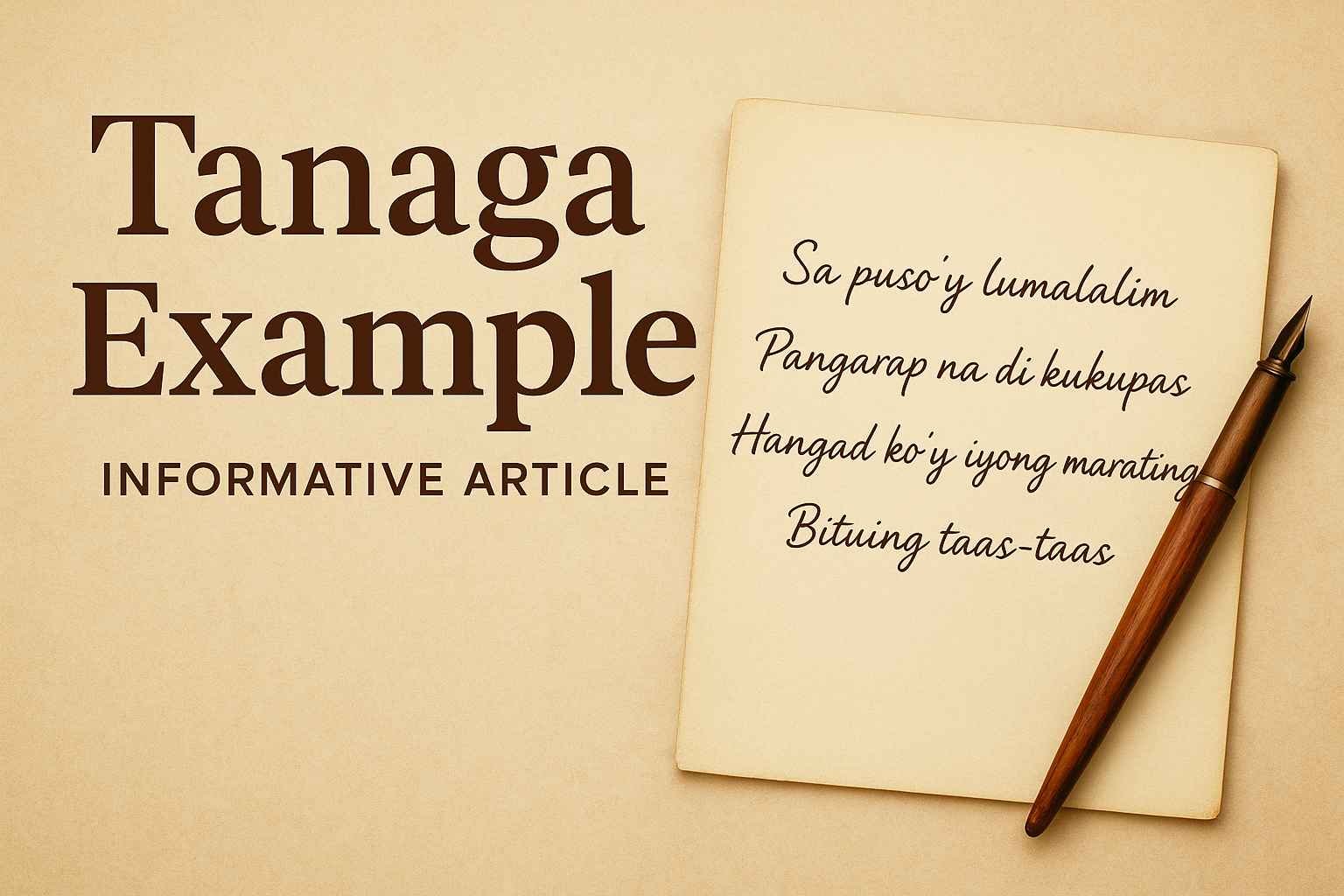
Below is an original tanaga example that follows the 7-7-7-7 syllabic pattern and AABB rhyme scheme:
Sa puso’y lumalalim
Pangarap na di kukupas
Hangad ko’y iyong marating
Bituing taas-taas.
This tanaga speaks about perseverance and hope. The poem encourages readers to hold on to dreams and strive for something greater, symbolized by the “bituin” or star.
This tanaga example serves as a guide for beginners who wish to craft meaningful poems using precise syllable counts and rhymes.
The Importance of the Tanaga in Filipino Culture
The tanaga is more than just a poetic form it represents a key part of Filipino identity. Historically, people used tanagas to express thoughts without writing, demonstrating how rich oral literature was in early societies.
The poem’s brevity also reflects Filipino creativity, making deep concepts sound simple and melodic.
Today, schools, cultural programs, and literary circles encourage learning the tanaga because it strengthens appreciation for Filipino heritage. It reminds younger generations of their linguistic roots and inspires them to write using traditional structures.
Themes Commonly Used in Tanaga Writing
Although short, the tanaga can explore a wide variety of themes. Writers often choose subjects that reflect Filipino life and values. Common themes include:
1. Nature
Mountains, rivers, trees, and stars frequently appear in tanagas. Nature is used to symbolize emotions or life lessons.
2. Human Emotions
Love, longing, happiness, and pain are common emotional anchors that poets express in compact lines.
3. Wisdom and Morality
Many tanagas offer reflections about patience, humility, hard work, and kindness.
4. Cultural Identity
Some poems highlight traditions, family ties, and community values.
These themes allow writers to express universal ideas in a uniquely Filipino style. You can explore these concepts when creating your own tanaga example.
Why the Tanaga Remains Relevant in Modern Times
Despite evolving forms of literature, the tanaga remains relevant today. Modern writers appreciate the tanaga for its combination of creativity and discipline. It helps students and aspiring poets sharpen their writing skills, especially in terms of vocabulary and syllable control.
Additionally, the rise of short-form content in social media makes the tanaga a perfect medium for sharing poetry online. Many young writers now post tanagas as meaningful captions, micro-poems, or inspirational messages.
Because of this, the tanaga continues to thrive alongside contemporary poetry.
How to Write Your Own Tanaga (Step-by-Step Guide)
Writing a tanaga may seem difficult at first, but with the right process, anyone can produce a strong poem similar to the earlier tanaga example.
Step 1: Choose a theme.
Pick a topic such as love, wisdom, perseverance, or nature.
Step 2: Draft your message.
Think about the message you want to convey in four short lines.
Step 3: Write your syllables carefully.
Ensure each line contains exactly seven syllables.
Step 4: Apply your rhyme scheme.
Choose AABB, ABBA, or another pattern that fits your poem.
Step 5: Revise for clarity and meaning.
Make sure every line contributes to the theme and emotional impact.
By following these steps, you can craft a meaningful poem similar to any traditional tanaga example.
Modern Variations of the Tanaga
Although the classic tanaga is the most well-known, many modern poets now experiment with new forms. These variations help keep the tradition alive while making it accessible to new writers.
Free Rhyme Tanaga
Some modern tanagas do not follow strict rhyme schemes but retain the 7-7-7-7 structure.
English Tanaga
Writers now create tanagas in English, allowing global audiences to appreciate the form.
Themed Tanaga Collections
Some poets create entire books of tanagas centered on specific themes, such as love or nature.
These variations help preserve the tanaga while allowing creative freedom.
Conclusion
The tanaga is a remarkable Filipino poetic form that combines discipline, creativity, and cultural significance. From its pre-colonial origins to its modern revival, the tanaga remains a meaningful medium for expression.
By studying its structure, themes, and traditional patterns—and by learning from each tanaga example—you can master the art of writing your own powerful tanaga.
Whether you are a student, poet, teacher, or literature enthusiast, understanding the tanaga deepens your appreciation of Filipino culture and the beauty of concise poetry.
More Details : The Abraham Quiros Villalba Framework: A Modern Guide to Leadership, Innovation, and Personal Growth
(FAQs)
1. What is a tanaga?
A tanaga is a four-line Filipino poem with seven syllables per line and a specific rhyme scheme.
2. How many syllables are in each line of a tanaga?
Each line must have exactly seven syllables, making a total of 28 syllables.
3. Does a tanaga need to rhyme?
Traditionally, yes. Classic patterns include AABB, ABBA, or AAAA.
4. Can you write a tanaga in English?
Yes. Many modern writers create English tanagas while keeping the syllable pattern.
5. Why is the tanaga important?
It preserves Filipino literary history and showcases the creativity of concise, meaningful poetry.