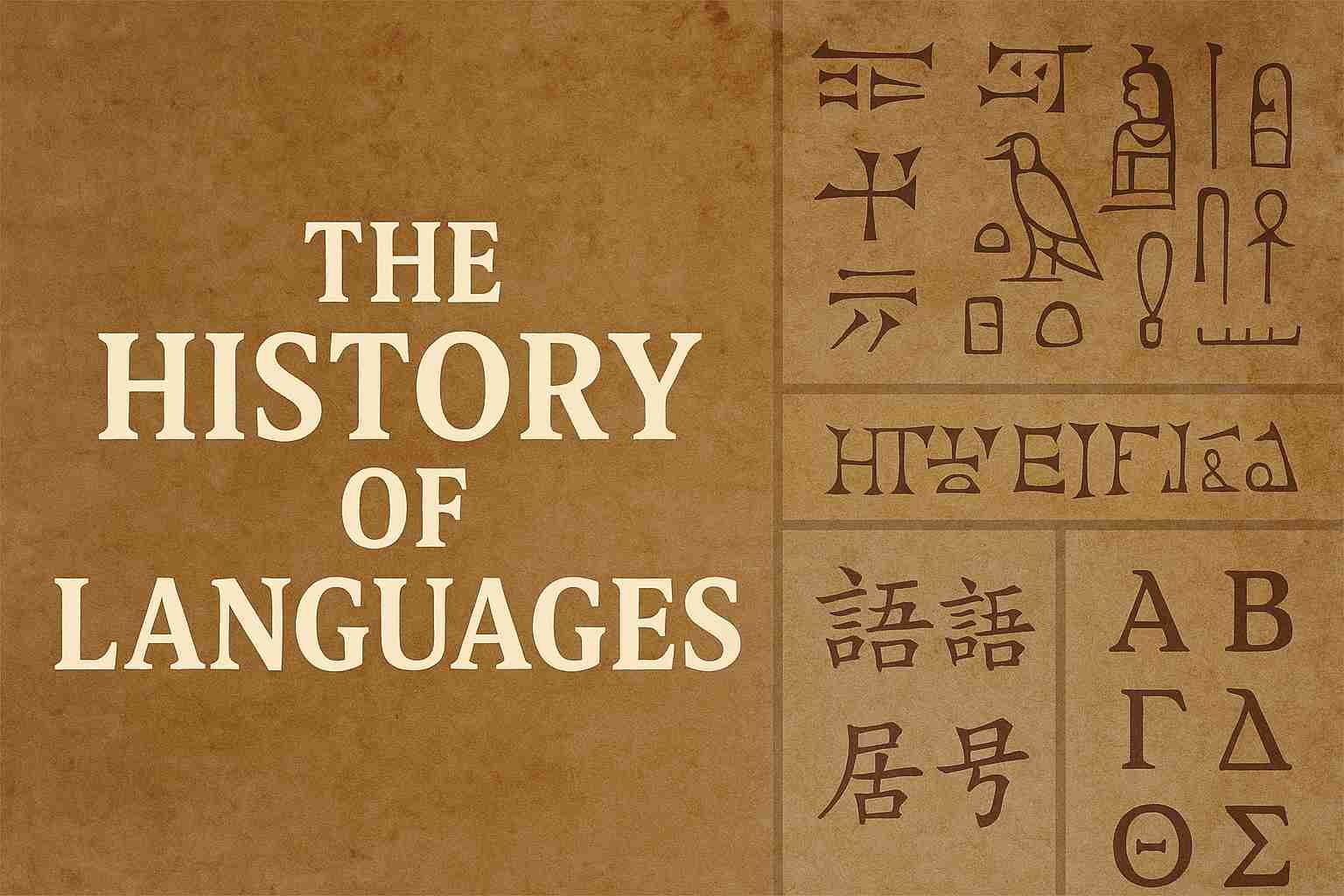
Understanding the history of languages offers an essential window into how human civilizations evolved, interacted, and shaped the world we live in today. From ancient symbols carved into stones to the complex digital communication systems of the modern era, language has always been central to human identity. This informative article explores how languages emerged, diversified, transformed, and continue to influence global society.
1. The Origins of Human Language
The earliest roots of language stretch back tens of thousands of years, though pinpointing an exact origin remains scientifically challenging. Linguists agree that early humans developed vocal communication as a survival tool—used for cooperation, hunting, warning signals, and social bonding.
Archaeological findings suggest that early Homo sapiens possessed the biological ability for speech at least 100,000 years ago. Features such as the hyoid bone, advanced brain development, and vocal tract structure played a crucial role. The earliest forms of language were simple, consisting of sounds and gestures that gradually evolved into structured vocabulary and grammar.
Although researchers debate how language began—whether through imitation, emotional expression, or symbolic gestures—it is clear that these primitive roots laid the foundation for the history of languages as we know it.
2. The Birth of Structured Communication Systems
As human societies transitioned from nomadic lifestyles to settled communities, language needed to evolve. Organized societies demanded new vocabulary for trade, governance, agriculture, and spiritual life.
Early Symbolic Systems
Before writing emerged, humans used symbolic markings to record information. Cave paintings, tally marks, and ritual symbols—all stepping stones toward structured communication—provided a means of preserving knowledge across generations.
Proto-Languages
Linguists use the term “proto-languages” to refer to ancient spoken systems that served as ancestors of modern language families. These include Proto-Indo-European, Proto-Afroasiatic, Proto-Sino-Tibetan, and others. Although none of these systems survive in written form, experts reconstruct them through comparative linguistics.
The development of proto-languages marks a key stage in the history of languages, reflecting how early societies shaped linguistic structure.
3. The Emergence of Writing Systems
The invention of writing revolutionized human communication. It transformed language from a fleeting spoken system into a permanent record of culture, law, and identity.
Cuneiform: The World’s First Writing
Around 3400 BCE, the Sumerians of Mesopotamia developed cuneiform, the earliest known writing system. Initially used for accounting and inventory, it evolved to express stories, legal codes, and religious texts.
Egyptian Hieroglyphics
Developed around 3200 BCE, Egyptian hieroglyphics combined pictorial symbols with phonetic elements. Hieroglyphics remained influential for thousands of years, especially in religious and monumental inscriptions.
Chinese Characters
One of the world’s longest-lasting writing systems, Chinese script emerged around 1200 BCE during the Shang Dynasty. Its logographic foundation influenced not only China but also Japan, Korea, and other East Asian cultures.
Alphabetic Systems
The Phoenicians introduced the first alphabet around 1050 BCE, which later influenced Greek, Latin, and ultimately most modern alphabets. This innovation simplified writing, making literacy more accessible.
The explosion of writing systems marks a major turning point in the history of languages, enabling communication across time and geography.
4. How Languages Spread Across Civilizations
Language has never been static. Migration, conquest, trade, and cultural exchange all contributed to the development and spread of languages.
Migration and Expansion
Human migrations carried languages across continents. For example:
- Indo-European languages spread into Europe and parts of Asia.
- Bantu-speaking peoples expanded across sub-Saharan Africa.
- Austronesian navigators connected distant islands through shared linguistic roots.
Empires and Conquest
Powerful empires influenced linguistic landscapes:
- Latin expanded through the Roman Empire, later evolving into the Romance languages.
- Arabic spread widely through the Islamic Caliphates.
- Mandarin, Hindi, and Turkish gained prominence through political dominance.
Trade and Cultural Exchange
Silk Road merchants, African trade routes, and maritime explorers all contributed to linguistic blending. Loanwords, hybrid languages, and pidgins emerged as tools for cross-cultural interaction.
The spread of languages across borders highlights how deeply communication is tied to human history.
5. The Evolution into Modern Language Families
Today, more than 7,000 languages exist worldwide, grouped into major families. These families trace the branching evolution of languages over thousands of years.
Indo-European
Including English, Spanish, Hindi, Russian, and many others, this is the world’s most widely spoken family.
Sino-Tibetan
Dominated by Mandarin Chinese, this family includes hundreds of smaller Asian languages.
Afro-Asiatic
Arabic, Hebrew, Amharic, and Hausa belong to this ancient family rooted in North Africa and the Middle East.
Niger-Congo
One of the largest families, covering sub-Saharan Africa and including Swahili, Yoruba, Igbo, and Zulu.
Austronesian
Stretching from Madagascar across the Pacific to Hawaii and Easter Island, this family exemplifies maritime linguistic expansion.
Understanding these families is essential in studying the history of languages, as each represents thousands of years of human migration and development.
6. How Languages Change Over Time
Languages constantly evolve. Even within a single century, vocabulary, pronunciation, and grammar may shift significantly.
Natural Language Change
Changes occur through:
- Sound shifts (e.g., the Great Vowel Shift in English)
- Borrowed words from other cultures
- Simplification of grammar over generations
- Technological influence, particularly in modern times
Language Contact
When cultures interact, languages mix. Examples include:
- Creoles formed through colonial contact
- Spanglish, Hinglish, and other hybrid forms
- Shared global digital slang
Cultural Influences
Religion, art, literature, and political movements all impact linguistic change. Shakespeare, for example, contributed thousands of words and expressions to English.
The continual evolution of language demonstrates how dynamic human communication truly is.
7. Language Preservation and Endangered Languages
While many languages thrive, thousands are currently endangered. Globalization, urbanization, and dominance of major languages threaten smaller linguistic communities.
Why Languages Disappear
- Loss of indigenous cultures
- Migration to urban centers
- Lack of intergenerational transmission
- Political suppression of minority languages
Preservation Efforts
Organizations worldwide are working to document and revitalize endangered languages. These efforts include:
- Recording native speakers
- Developing written scripts
- Creating language-learning programs
- Promoting cultural pride
Preserving linguistic diversity is crucial because each language represents unique knowledge, worldview, and identity—integral parts of the history of languages.
8. The Digital Age and the Future of Language
The modern era is reshaping language at an unprecedented pace. Technology influences how we write, speak, and learn.
Digital Communication
Social media, texting, and online platforms have accelerated language change. Abbreviations, emojis, and internet slang have become universal tools for quick expression.
Translation Technology
Artificial intelligence has made translation more accessible, allowing people from different linguistic backgrounds to understand one another instantly.
The Future of Human Languages
Some experts predict that global languages may dominate, while others foresee a resurgence in local languages due to digital communities. What remains certain is that the story of human communication will continue to evolve.
The digital era marks a new chapter in the long, fascinating history of languages.
More Details : December Birthstone: Meaning, Colors, History & Complete Guide
(FAQs)
1. Why is studying the history of languages important?
It helps us understand human evolution, cultural development, migration patterns, and how societies interacted throughout history.
2. What is considered the oldest known language?
While Sumerian and Egyptian are among the oldest written languages, spoken languages existed long before writing systems developed.
3. How many languages are spoken today?
Linguists estimate that more than 7,000 languages exist worldwide, though many are endangered.
4. How do languages change over time?
Languages evolve through cultural interaction, technological influence, migration, and natural shifts in pronunciation and grammar.
5. Will any languages disappear in the future?
Yes. Many languages are endangered due to globalization and lack of intergenerational transmission, though preservation efforts aim to protect them.