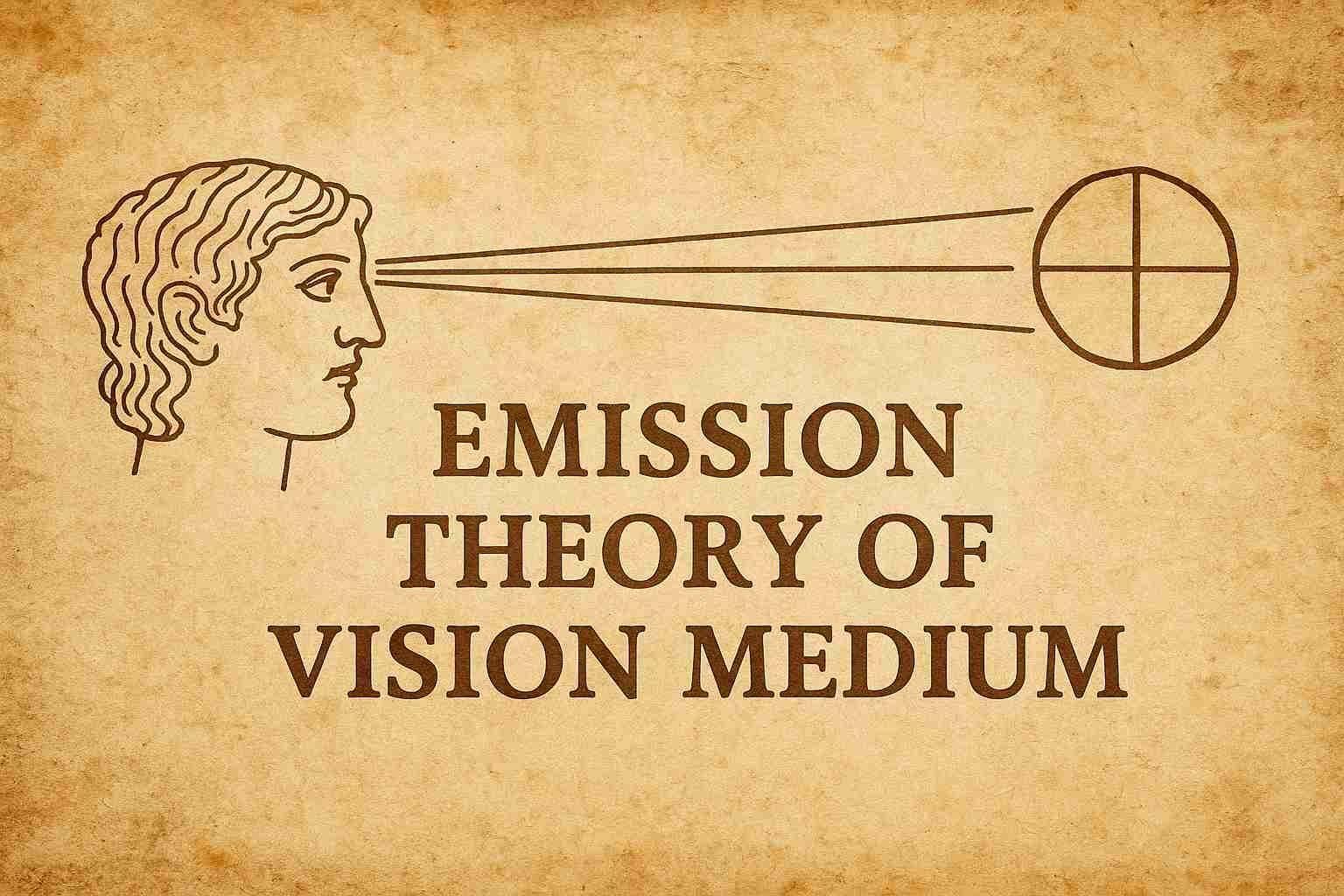
Human vision has always been a subject of deep curiosity. Long before modern science explained how light enters the eye, ancient thinkers proposed bold ideas to understand how we see the world. One of the most fascinating early explanations is the emission theory of vision medium, a concept that shaped the foundations of ancient optical philosophy.
This theory, although outdated today, played a major role in the evolution of scientific thought. In this article, we explore its origins, principles, strengths, flaws, and historical impact — all in a clear and engaging style.
What the Emission Theory of Vision Medium Actually Says
The emission theory of vision medium suggests that the eyes emit rays or “visual fire” toward objects. These rays interact with the medium between the eye and the object, forming a visual connection that allows us to see shapes, colors, and motion.
To ancient philosophers, this idea made sense: if light helps us see, maybe the eye also produces some kind of light.
Where the Theory Comes From
Greek Philosophers and Early Ideas
The concept originated in early Greek philosophy, where thinkers such as Empedocles believed the eye contained fire that extended outward. This fire combined with external light, making vision possible.
Plato’s Vision Stream
Plato expanded this idea, proposing that the eye emits a radiant stream that merges with daylight. This merging created a pathway between the viewer and the viewed object.
Euclid and Mathematical Vision
Euclid, a major influence in geometry, used the emission concept to build mathematical rules for vision. His work explained angles, distances, and the way visual rays travel in straight lines.
How the Medium Plays a Role in Vision
The emission theory of vision medium did not suggest empty space between the eye and objects. Instead, philosophers believed the “medium” acted as a channel for visual rays.
Functions of the Vision Medium
- Carries visual rays from eyes to objects
- Supports the connection between observer and environment
- Explains why vision fails in darkness
- Gives structure to the idea of optical flow
This ancient understanding, though incorrect, laid the groundwork for later optical science.
Supporters and Their Perspectives
Stoics: Vision as a Physical Force
Stoic philosophers believed vision rays were physical in nature. According to them, visual rays spread outward like a cone, touching objects and transmitting information back to the mind.
Ptolemy: Experiments with Light
Ptolemy experimented with reflection and refraction, combining geometry with the emission concept. Even when some results contradicted the theory, he continued to interpret vision through the emission model.
Why the Theory Eventually Failed
Although widely accepted for centuries, the emission theory of vision medium faced serious scientific challenges.
No Evidence of Eye-Emitted Rays
Biological study of the eye showed no mechanism for producing light or rays.
Darkness Problem
If eyes emitted light, humans should be able to see in total darkness — but they can’t.
Intromission Theory Replaces It
Aristotle and later Islamic scholars, especially Ibn al-Haytham (Alhazen), proved that light enters the eye, not the other way around. This transformed the understanding of optics forever.
How the Theory Influenced Future Science
Even though incorrect, the emission theory of vision medium contributed to major developments:
Growth of Optical Geometry
Euclid’s geometric approach helped shape medieval and Renaissance optical studies.
Fuel for Scientific Debate
The conflict between emission and intromission theories encouraged deeper research into how light and the eye work.
Philosophical Impact
The theory affected early discussions about perception, consciousness, and human experience.
Modern Understanding of Vision
Today we know that:
- Light reflects off objects
- It enters the eye
- The cornea and lens focus it
- The retina converts it into signals
- The brain forms meaningful images
Modern science is entirely based on light entering, not exiting, the eye — the exact opposite of what the emission theory proposed.
Why Studying This Ancient Theory Still Matters
Even though it is scientifically outdated, studying the emission theory of vision medium helps us understand:
- How ancient thinkers approached scientific problems
- The evolution of human understanding
- The importance of questioning and testing ideas
- The roots of modern optical research
It is a reminder that knowledge builds over centuries of exploration, correction, and discovery.
Conclusion
The emission theory of vision medium holds a special place in the history of science. It reflects humanity’s early attempts to explain one of the most complex senses — vision. While today’s science paints a very different picture, the ancient theory remains a symbol of human curiosity and the long, fascinating journey toward scientific truth.
More Details : Why I’m Building CapabiliSense Medium
FAQs
1. Who first suggested the emission theory?
Early Greek philosophers like Empedocles introduced the idea, later refined by Plato and Euclid.
2. What does the emission theory of vision medium claim?
It claims the eyes emit rays that connect with objects through a surrounding medium.
3. Why was the theory proven wrong?
Because experiments and biological studies showed that light enters the eye rather than being emitted by it.
4. Who replaced this theory with a better explanation?
Aristotle and Ibn al-Haytham played major roles in establishing the correct intromission theory.
5. Why is the theory still studied today?
To understand the history of science, early optical ideas, and philosophical approaches to perception.