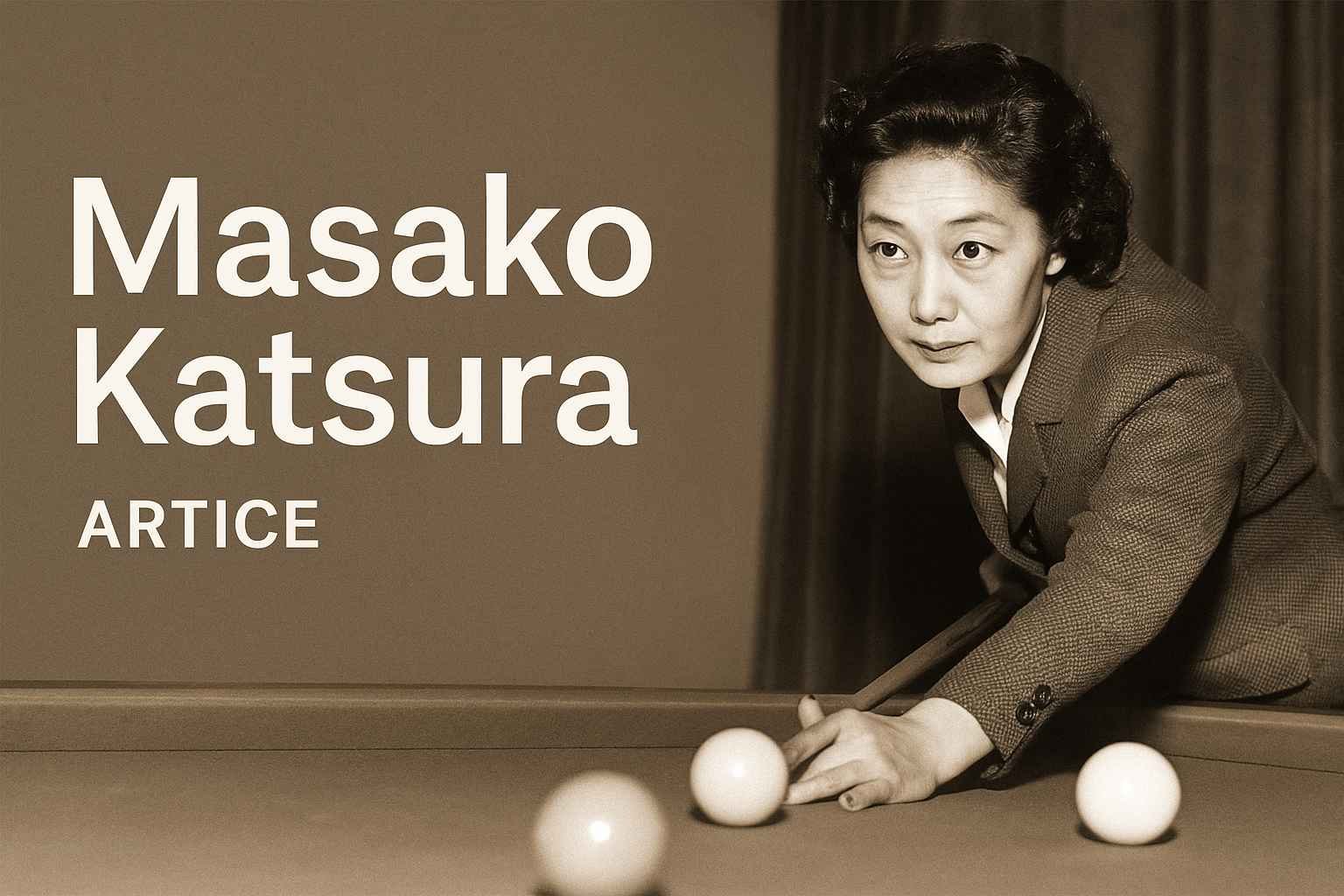
In the mid-20th century, billiards was considered a man’s game. Professional pool halls were almost entirely filled with men, and women were rarely seen competing at the same level. Yet one woman defied all odds — Masako Katsura. Known worldwide as The First Lady of Billiards, she was not only the first woman to compete internationally against men in professional billiards but also became a cultural icon who transformed perceptions of women in sports.
Her journey from post-war Japan to the grand stages of international billiard championships is a story of determination, skill, and resilience. This article explores her life, achievements, and lasting influence on cue sports.
Early Life: The Birth of a Legend
Masako Katsura was born in Tokyo, Japan, in 1913. Growing up in a traditional Japanese household, her life took an unusual turn at the age of 14 when she began working in her brother-in-law’s billiard hall. It was here that her fascination with the game began. Unlike many girls of her time, she was encouraged to play and practice — a decision that would later make history.
Under her brother-in-law’s guidance, Katsura mastered the fundamentals of carom billiards, a discipline requiring not just strength but remarkable precision and strategy. By her late teens, she was already a sensation in Japan, winning local tournaments and capturing public attention.
Rising Fame in Japan
By the 1930s, Masako Katsura had become one of Japan’s most talented players. Her graceful yet powerful technique stunned audiences. At a time when few women played billiards professionally, she stood out not just for her gender but for her exceptional skill.
Katsura dominated national tournaments, earning respect from male players who initially underestimated her. Her mastery of the cue ball and her calm composure under pressure made her a formidable competitor. Newspapers began referring to her as “Japan’s billiard queen,” and her fame spread beyond the local billiard halls of Tokyo.
Journey to International Stardom
After World War II, American soldiers stationed in Japan were amazed to see a woman defeating experienced male players in billiards. Among them was Vernon Greenleaf, a top U.S. billiard champion, who recognized Katsura’s talent and encouraged her to compete internationally.
In 1951, she moved to the United States and entered the world stage of billiards — an extraordinary step for a Japanese woman in postwar America. Despite facing language barriers, cultural differences, and gender bias, she remained focused and determined.
Her entry into the World Three-Cushion Billiards Championship marked a historic milestone: Masako Katsura was the first woman ever to compete at that level.
Competing with the World’s Bes
At the 1952 World Championship in San Francisco, Katsura went head-to-head with legends such as Willie Hoppe, the 51-time world champion. Though she didn’t win the championship, she finished among the top competitors — an astonishing feat given her relatively recent arrival on the international scene.
Crowds admired her elegance, control, and focus. American newspapers praised her as a trailblazer who had “brought grace and skill to the toughest game on earth.” Over the next few years, she continued to compete in international tournaments, frequently placing among the top contenders and earning invitations to exhibition matches across the U.S.
Media Recognition and Cultural Impact
During the 1950s, Masako Katsura became a media sensation. She appeared on American television shows such as You Asked for It and What’s My Line?, introducing audiences to a new image of women in sports — one defined by intelligence, confidence, and mastery.
Her public appearances helped popularize billiards at a time when the game’s popularity in the United States was declining. She inspired not only women but also younger generations of players who saw in her a symbol of perseverance and grace.
In Japan, her success abroad made her a national hero. Newspapers followed her every tournament, and she was celebrated as a pioneer who represented the strength and talent of Japanese women on a global stage.
Playing Style and Technique
Masako Katsura’s playing style was marked by precision, strategy, and finesse. She excelled at three-cushion billiards, a form of carom billiards where the cue ball must contact the rail at least three times before hitting the final target ball.
Her understanding of angles and ball control was exceptional. She relied more on technique and mental calculation than physical power proving that billiards is as much a game of intellect as it is of skill. Her calm demeanor and strategic approach became a model for players worldwide.
Challenges and Gender Barriers
Despite her fame, Katsura faced numerous challenges. She often encountered sexism and skepticism from male players and commentators who believed billiards was unsuitable for women. However, her success dismantled such biases.
She proved that gender had no bearing on excellence in cue sports. Her persistence opened doors for women in professional billiards, paving the way for future stars like Jean Balukas and Allison Fisher. Katsura’s career demonstrated that passion and dedication could overcome even the strongest cultural barriers.
Later Years and Retirement
By the early 1960s, Masako Katsura gradually retired from competitive play. After her husband’s death in 1967, she returned to Japan, where she continued to teach and occasionally participate in exhibition games.
Although she faded from public life, her influence persisted. Players who trained under her continued to promote her methods and values discipline, focus, and respect for the game. In her later years, she lived quietly in Tokyo until her passing in 1995.
Legacy of Masako Katsura
Today, Masako Katsura remains an icon in the world of billiards. She broke gender barriers long before the term “gender equality” became widely recognized in sports. Her courage and mastery of the game made her a legend whose impact continues to inspire.
The Billiard Congress of America and other organizations have since recognized her contributions, celebrating her as a true pioneer. She not only raised the profile of billiards but also changed the way the world viewed women in competitive sports.
Her story reminds us that talent knows no gender and that determination can rewrite history.
Influence on Modern Billiards
Modern female billiard players owe much to Katsura’s groundbreaking career. The rise of women’s billiard tournaments and the inclusion of female divisions in international championships are, in part, her legacy.
Professional players often cite Katsura as a role model for combining elegance with technical brilliance. Even today, video archives and historical analyses of her matches are studied by billiard enthusiasts and scholars. Her influence extends beyond the sport, symbolizing progress, equality, and cultural connection between East and West.
Conclusion:
Masako Katsura was more than a billiards champion she was a pioneer who broke through barriers of gender, culture, and time. Her story is a powerful reminder of what dedication and courage can achieve.
She entered a man’s world and left it forever changed. Through her achievements, she proved that excellence transcends boundaries, inspiring generations to follow their passion fearlessly. Her name continues to echo in billiard halls across the world — a name synonymous with brilliance, grace, and perseverance.
More Details : Monique Net Worth – Unveiling the Life and Fortune of a Comedy Queen
FAQs
1. Who was Masako Katsura?
Masako Katsura was a Japanese professional billiard player who became the first woman to compete internationally against men in world championships during the 1950s.
2. Why is Masako Katsura famous?
She is best known for breaking gender barriers in billiards and earning the title The First Lady of Billiards due to her groundbreaking achievements in a male-dominated sport.
3. What kind of billiards did Masako Katsura play?
She specialized in three-cushion billiards, a highly technical form of the game requiring precise cue ball control and deep strategic thinking.
4. How did Masako Katsura influence women in sports?
Her success proved that women could compete on equal footing with men in skill-based sports, inspiring greater inclusion and respect for female athletes worldwide.
5. When did Masako Katsura pass away?
Masako Katsura passed away in 1995, but her legacy continues to inspire billiard players and sports enthusiasts globally.