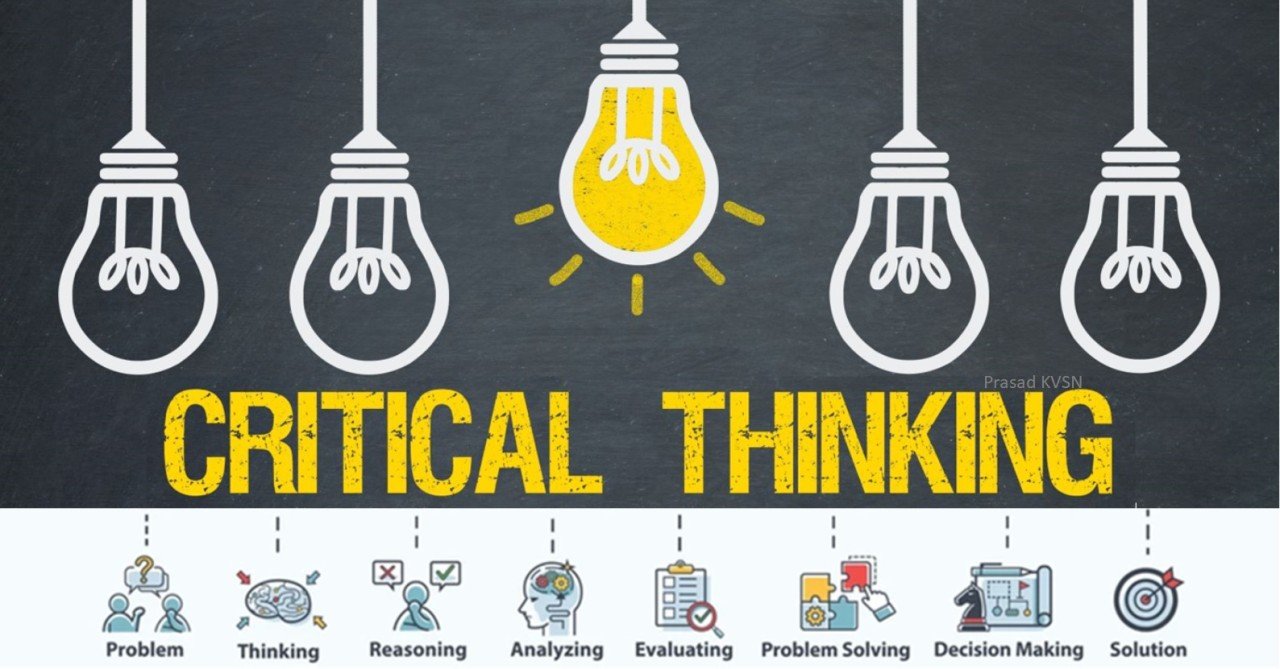
In a world overloaded with information, the ability to think critically is no longer a luxury — it’s a necessity. Whether you’re a student analyzing data, a professional making business decisions, or simply someone navigating daily challenges, honing your critical thinking skills helps you separate facts from assumptions. The following guide explores Critical Thinking Exercises that train your brain to analyze, evaluate, and act with logic and creativity.
Understanding Critical Thinking
Before diving into the exercises, it’s essential to understand what critical thinking really means. It’s the disciplined process of actively and skillfully conceptualizing, applying, analyzing, synthesizing, and evaluating information to reach a well-reasoned conclusion. In simpler terms, critical thinking means not taking things at face value but questioning and verifying before forming judgments.
Critical thinking isn’t about being skeptical of everything; rather, it’s about approaching information with curiosity, logic, and open-mindedness. The Critical Thinking Exercises outlined below are designed to help you develop this mindset systematically.
Why Critical Thinking Matters in Everyday Life
Critical thinking improves nearly every aspect of modern life. From managing finances to interpreting news, every decision benefits from clear, rational analysis. When you develop critical thinking habits, you can detect biases, spot weak arguments, and make confident choices even in uncertainty.
For professionals, strong critical thinking leads to better problem-solving and innovation. For students, it enhances comprehension, writing, and research. And for everyday thinkers, it cultivates independence — freeing you from misinformation and emotional manipulation.
Exercise 1: The “Why Chain” Technique
The “Why Chain” is a simple yet powerful exercise that enhances analytical depth. Start by asking why about any claim or belief — then ask why again for each answer you give. Repeating this five times uncovers assumptions and root causes.
For example:
Statement: “I think I’m bad at public speaking.”
Why? “Because I get nervous.”
Why? “Because I fear judgment.”
Why? “Because I care too much about others’ opinions.”
By the fifth why, you reach the emotional or logical root of your belief, creating opportunities for genuine growth.
Exercise 2: Reverse Thinking
Reverse thinking challenges conventional logic by flipping the problem upside down. Instead of asking “How can I succeed?” ask “How could I fail?” This shift forces you to identify potential weaknesses, blind spots, and errors before they occur.
This Critical Thinking Exercise is particularly effective in business strategy, risk analysis, and creative problem-solving. It encourages proactive thinking and sharpens your ability to foresee and prevent future issues.
Exercise 3: The Devil’s Advocate
The “Devil’s Advocate” exercise involves defending the opposite of your own viewpoint. If you believe a specific policy is good, argue against it. If you think a product will sell, argue why it won’t.
This method improves perspective-taking and logical reasoning. It also helps eliminate emotional bias by forcing you to consider all angles objectively. The more you practice this, the more balanced and informed your decisions become.
Exercise 4: The Fact vs. Opinion Drill
In today’s digital world, misinformation spreads rapidly. This drill trains your mind to distinguish facts from opinions. Collect five online news headlines or social media posts and identify which statements are factual and which are interpretations.
This Critical Thinking Exercise refines your ability to filter out emotional or misleading information. Over time, it develops media literacy — a vital skill in the age of information overload.
Exercise 5: The “Evidence Table” Approach
The Evidence Table is a structured method for logical evaluation. When faced with a decision, create a simple table with two columns: “Evidence For” and “Evidence Against.” List all supporting and opposing data points.
This technique helps you avoid confirmation bias — the tendency to seek only information that supports your existing belief. By weighing both sides equally, your reasoning becomes more balanced, systematic, and data-driven.
Exercise 6: Socratic Questioning
Named after the ancient philosopher Socrates, this exercise uses disciplined questioning to challenge assumptions. The process involves asking questions like:
- What’s the evidence for this claim?
- Could there be another explanation?
- What’s the consequence if I’m wrong?
- Who benefits from this belief?
Socratic questioning enhances your reasoning depth and prevents emotional or impulsive decisions. Practicing it daily can dramatically boost intellectual curiosity and mental clarity.
Exercise 7: Pattern Recognition
Pattern recognition strengthens both analytical and creative thinking. This Critical Thinking Exercise involves identifying trends or relationships between seemingly unrelated ideas. For example, try linking historical events to modern challenges or drawing parallels between business strategies and natural ecosystems.
Recognizing patterns helps in forecasting, innovation, and problem-solving. It trains your mind to see connections others might miss — a valuable edge in professional and academic settings.
Exercise 8: “The Five Perspectives” Analysis
This technique requires viewing a single issue from five different roles — for instance:
- Yourself
- A close friend
- A critic
- A professional expert
- A neutral observer
By switching perspectives, you challenge cognitive rigidity and expand empathy. This approach encourages flexible thinking — one of the hallmarks of critical reasoning.
Exercise 9: The Decision Matrix
When faced with complex choices, emotions can cloud logic. A Decision Matrix is a simple grid that lists all available options along with factors that influence the decision (cost, time, impact, risk, etc.). You then score each factor to find the most rational choice.
This Critical Thinking Exercise is widely used in management, engineering, and research. It replaces guesswork with structured evaluation, improving both accuracy and confidence.
Exercise 10: Reflection Journaling
Reflection journaling is one of the most personal and effective exercises for improving critical thought. Each day, write down one decision you made and analyze it:
- What facts did I rely on?
- What assumptions did I make?
- What could I have done differently?
Regular journaling fosters self-awareness and metacognition — the ability to think about your thinking. Over time, it reveals patterns in reasoning and helps you make wiser, more consistent judgments.
How to Incorporate These Exercises Into Daily Life
The key to mastery lies in consistency. Start small — dedicate 15 minutes each day to one or two of these drills. Over weeks, combine them into habits. For example, use the Evidence Table for decision-making, practice Socratic questioning during discussions, and end your day with a reflection journal entry.
Integrating Critical Thinking Exercises into real-world activities ensures long-term cognitive growth and adaptability. You’ll notice improved focus, better argumentation skills, and a more disciplined approach to problem-solving.
Benefits of Practicing Critical Thinking Exercises
Practicing these exercises regularly delivers measurable cognitive and emotional benefits:
- Improved decision-making: Logical frameworks reduce impulsivity.
- Enhanced creativity: Diverse perspectives spark innovation.
- Better communication: Clear reasoning leads to persuasive dialogue.
- Reduced bias: Awareness of assumptions limits judgment errors.
- Stronger leadership: Analytical clarity builds trust and confidence.
By refining how you analyze and interpret data, you not only boost brainpower but also increase your capacity for empathy, strategy, and wisdom.
The Science Behind Critical Thinking Development
Cognitive science confirms that the brain is highly adaptable. Neural pathways strengthen with repetition, meaning consistent practice in reasoning tasks improves mental agility. Activities like reverse thinking or the “Why Chain” enhance neural connectivity in the prefrontal cortex — the brain region responsible for decision-making and planning.
In essence, Critical Thinking Exercises aren’t just intellectual workouts; they’re neurological training sessions that rewire your mind for clarity and resilience.
Overcoming Common Barriers to Critical Thinking
Even with good habits, barriers like bias, emotional reasoning, and information overload can cloud judgment. Awareness is the first step to overcoming these obstacles.
- Bias: Use structured tools like Evidence Tables to ensure objectivity.
- Emotional reasoning: Pause before reacting; analyze intent and data.
- Overconfidence: Seek feedback and embrace alternative perspectives.
- Mental fatigue: Balance analysis with rest and mindfulness.
Developing true critical thinking requires patience and humility — the willingness to admit uncertainty and keep learning.
Final Thoughts:
Critical thinking is not a one-time skill but a lifelong discipline. These exercises are meant to be practiced continuously — evolving with your personal and professional growth. As your analytical depth expands, you’ll approach challenges with greater calm, insight, and confidence.
The more consistently you engage in Critical Thinking Exercises, the stronger and more adaptable your mind becomes — ready to navigate any complexity the modern world throws your way.
More Details : Pam Bondi Weight Loss Journey: An Inspiring Story of Health and Transformation
FAQs
1. How often should I practice critical thinking exercises?
Aim for at least 15–20 minutes daily. Consistency matters more than intensity. Over time, these habits naturally integrate into your decision-making process.
2. Are these exercises suitable for students and professionals alike?
Absolutely. They’re flexible enough for academic learning, business strategy, and personal development.
3. Can critical thinking be taught or is it an innate skill?
It can be taught and developed. Regular practice, feedback, and reflection dramatically improve reasoning ability over time.
4. What’s the most effective exercise for beginners?
Start with the “Why Chain” and “Fact vs. Opinion” drills. They’re simple yet powerful for identifying assumptions and improving logical clarity.
5. How long does it take to notice improvements?
Many people report clearer thinking within a few weeks of consistent practice, but long-term mastery takes months of continuous engagement.